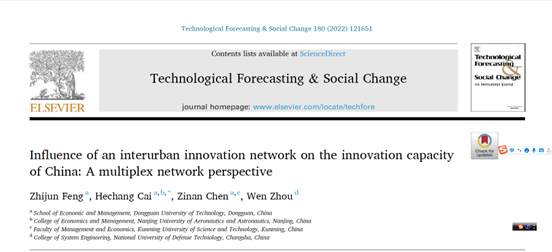
Recently, the research paper titled "Influence of an interurban innovation network on the innovation capacity of China: A multiplex network perspective," co-authored by Associate Professor Feng Zhijun of the School of Economics and Management, graduate students Cai Hechang and Chen Zinan, and Associate Professor Zhou Wen of the National University of Defense Technology, was published in Technological Forecasting & Social Change, a top-tier international journal in the field of innovation management (SSCI Q1, ABS Three Stars, Impact Factor: 8.593).
The study argues that interurban innovation networks are typical multiplex networks formed by the spatial coupling and interaction of technology cooperation flows and technology transfer flows. However, research on interurban innovation networks from a multiplex network perspective is rare. This study constructs an interurban technology cooperation-transfer network from a multiplex network perspective and employs a spatial Durbin model to reveal how its structural characteristics affect urban innovation capacity. The findings are as follows:
(1) There are significant disparities in the innovation capacity of Chinese cities, mainly reflected in the differences between cities in the eastern region and those in other regions. The innovation capacity of Chinese cities shows obvious spatial heterogeneity and agglomeration characteristics.
(2) China's interurban technology cooperation-transfer network exhibits high spatial coupling. The degree-strength division of the network has clear boundaries. In addition, the degree-strength division and PageRank classification show a certain degree of spatial overlap and correlation characteristics, with community spaces displaying agglomeration.
(3) In the relationship between the structural embeddedness of China's interurban technology cooperation-transfer network and urban innovation capacity, node degree has a U-shaped relationship with urban innovation capacity. Node strength and PageRank value have positive effects on urban innovation capacity. Meanwhile, node PageRank value has a significant positive spatial spillover effect, while both node degree and node strength have significant negative spatial spillover effects. These findings can be used to develop more effective interurban innovation networks, which will contribute to the innovation development of Chinese cities.
The publication of this paper marks a new breakthrough for faculty of the School of Economics and Management in publishing in a top-tier international journal in the field of innovation management. It is a landmark academic achievement resulting from the school's recent efforts to continuously improve the quality of graduate education, strengthen research teams, and foster a conducive research atmosphere. It also significantly reflects the effectiveness of the school's initiatives to encourage both faculty and students to enhance their research capabilities and to advance the development of first-level disciplines.
Paper link: https://doi.org/10.1016/j.techfore.2022.121651