At 10:30 a.m. on September 23, the School’s inaugural opening ceremony and faculty-student meeting for international postgraduate students was grandly held in the tiered lecture hall of the Academic Conference Center on the Songshan Lake Campus. Members of the School leadership team Lu Xiaojun, Liu Chuan, Huang Xiang, Li Wei, and Jin Long; Song Xuejing, Section Chief of the Training Section of the Graduate School; Ms. Hao Lixia, representative of the International College; representatives of supervisors and course instructors; and all 2026-cohort international postgraduate students in International Business and Digital Economy attended the event. The meeting was chaired by Vice Dean Jin Long.
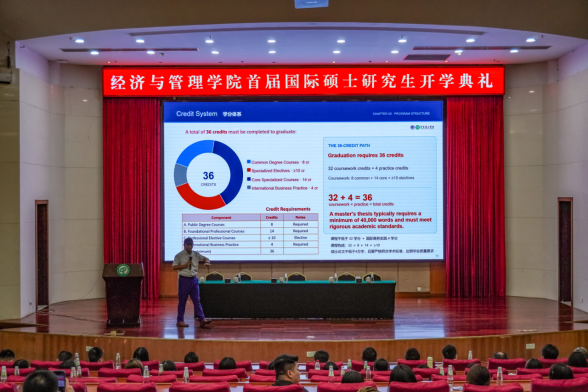
The ceremony opened amid warm applause. Vice Dean Liu Chuan delivered a welcome address. On behalf of the School, he extended the warmest welcome and sincerest congratulations to the 98 new international postgraduate students who had crossed mountains and seas and arrived as promised. He noted that those present were not only the first international postgraduate students of the university and the School of Economics and Management, but would also become bridges for the common development of Dongguan and the world. He introduced the land beneath their feet: Dongguan is a world-renowned international manufacturing city and an important node city in the Guangdong-Hong Kong-Macao Greater Bay Area. Its numerous industrial and high-tech enterprises make it a natural laboratory for observing “Made in China,” studying global trade, and exploring the digital economy. The School of Economics and Management upholds the core values of “benefiting people’s livelihood through economic governance and governing the world through talent management.” Its two master’s programs in International Business and Digital Economy are deeply rooted in this fertile industrial soil. The School’s training is application-oriented: in the classroom there are real corporate cases; outside the classroom there is the industrial frontline of the Greater Bay Area. What students study here is not only books, but also a real, multidimensional, and developing China.
In his speech, Vice Dean Liu Chuan put forward four hopes for the students. First, study with peace of mind and be a diligent learner, adapt to the new learning rhythm as soon as possible, and build a solid professional foundation. Second, understand China and be a sincere observer, step out of the classroom and into enterprises and cities, observe China with their own eyes, and also tell their own countries’ stories to Chinese teachers and students. Third, learn from each other and be communicators among civilizations, learn tolerance amid differences, and gain friendship through exchange. Fourth, observe discipline and rules and be practitioners of rules, consciously abide by university rules and regulations, and uphold academic norms and academic integrity. He also noted that the School had made careful preparations since the summer, offering bilingual courses, selecting experienced and responsible postgraduate supervisors, and establishing a coordinated service mechanism with the International College and the International Exchange Office, so that students have someone to teach them in their studies, someone to manage their daily lives, and someone to help them when difficulties arise.
Afterwards, Vice Dean Li Wei gave a comprehensive introduction to the School of Economics and Management from the perspectives of its development history, discipline layout, faculty, and educational features. He introduced that the School’s discipline and program layout is highly compatible with Dongguan’s industrial development, that it is a pioneer and main force in the university’s internationalization, that it has a group of full-time teachers with rich teaching experience and an international perspective, and that it has established university-enterprise cooperation relationships with many well-known enterprises in Dongguan, providing a broad platform for international students to gain an in-depth understanding of Chinese enterprises and Chinese industries. He encouraged students to cherish the learning opportunity, make full use of the School’s high-quality resources, and strive to become business talent with international competitiveness.
Mr. Fang Xiang gave an in-depth interpretation of the talent training programs for International Business and Digital Economy. He introduced in detail the training objectives, curriculum system, training components, and assessment requirements, noting that the two programs had optimized course design in light of the characteristics of international students and highlighted bilingual teaching and case-based teaching. He advised students to plan their studies scientifically according to the training programs, identify their research direction as early as possible, and actively communicate with their supervisors, so as to lay a solid foundation for successfully completing their studies.
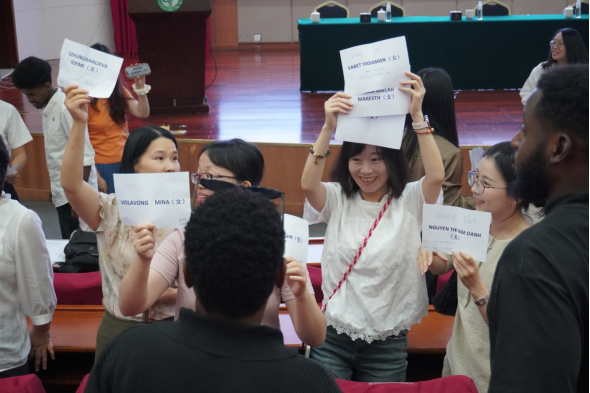
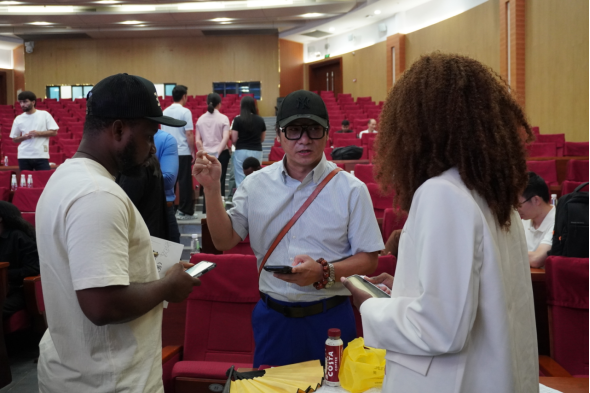
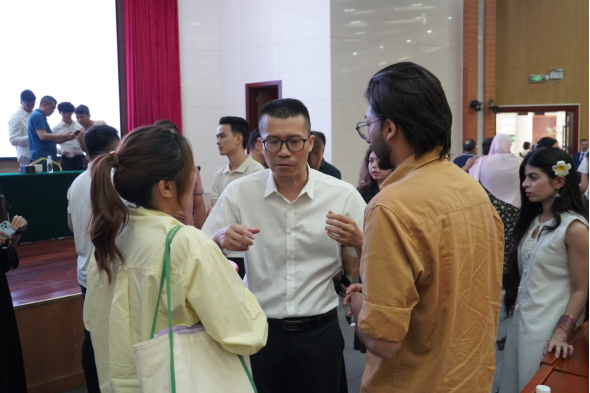
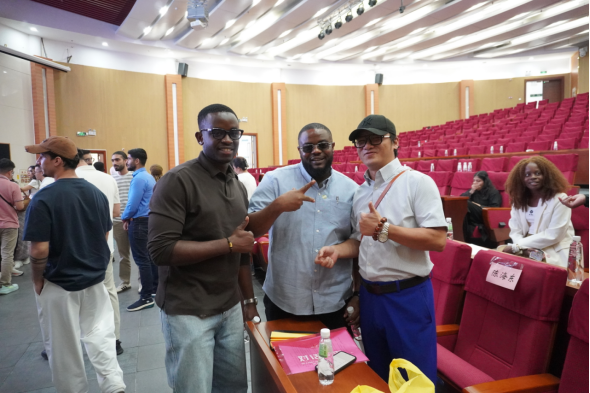
During the faculty-student exchange session, School leaders and teachers interacted warmly with students and had friendly exchanges, and the atmosphere was lively and harmonious. As the saying goes, those who share the same vision do not regard mountains and seas as far. The successful holding of this opening ceremony and faculty-student meeting marked the official launch of the School’s first international postgraduate training work. Next, the School will continue to do a good job in course teaching, supervisor guidance, and service support, help international postgraduate students integrate into campus life and gain a real sense of China as soon as possible, and make a brilliant start and a satisfactory response on the new journey of international talent training.

(Written by and first reviewed by: Cui Tong; second reviewed by: Liu Chuan and Shen Mengqi; final reviewed by: Huang Xiang)
